
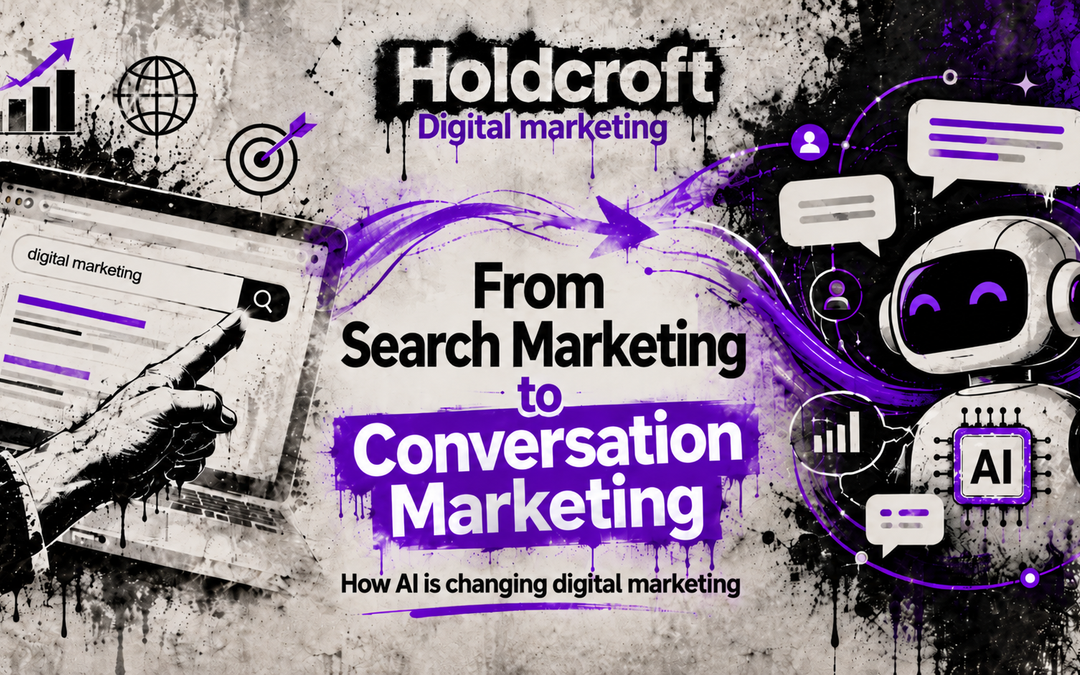
For years, digital marketing has revolved around a relatively familiar objective: get found, earn the click and convert the visitor.
Search engine optimisation helped brands appear in Google. Paid search allowed businesses to buy visibility around high-intent keywords. Social media advertising helped marketers interrupt, inspire and retarget. Websites and landing pages then took over, providing the information and reassurance needed to turn attention into action. Artificial intelligence is beginning to disrupt that journey. The contemporary digital marketing question is no longer simply, “How do we get customers to click?” It is increasingly becoming, “What happens when the customer can have a conversation with the advertising, the search engine and the brand before they ever visit our website?”
That question matters because platforms such as OpenAI’s ChatGPT and Google’s Gemini are increasingly positioning artificial intelligence between the customer and the organisation.
OpenAI and the rise of conversational advertising
One of the most interesting developments comes from OpenAI and its move further into advertising.
OpenAI has introduced the concept of Sponsored Agents, allowing users to move beyond simply viewing an advertisement and potentially enter into a conversation with an AI agent representing the advertiser. On the surface, this may look like just another new advertising format. In reality, the implications could be much more significant.Think about something as ordinary as buying a dining table. Traditionally, a customer might search for a product, click an advert, arrive on a website, compare a few options and eventually make a purchase.
A conversational journey could look very different. Instead of being shown an advert saying “Dining tables from £599”, the customer could ask an AI system, “I have a three metre by four metre dining room, two young children and a budget of £800. What would you recommend?” At that point, the advertising experience begins to perform several functions at once. It can answer questions, interpret customer needs, compare alternatives, explain features and help narrow down the decision. In other words, part of the work traditionally undertaken by the website, salesperson, FAQ page and customer service team can potentially happen inside the advertising experience itself. That is more than a change in format. It could represent a change in the architecture of the customer journey.
Google is moving in the same direction
This shift is not limited to ChatGPT.
Google continues to build Gemini into Search, advertising and its wider marketing ecosystem. At Google Marketing Live, the company outlined how Gemini is being used to transform campaign creation, search experiences and advertising formats. Google has also been developing new advertising formats designed specifically for the AI era of Search. The important change is that search is becoming less about simply displaying links and more about interpreting intent, synthesising information and helping users make decisions. That matters for marketers because it inserts another layer between the customer and the brand. Historically, Google Search helped people find information. Increasingly, Gemini can help interpret the question, evaluate options and support the decision. As a result, marketers may need to think about visibility in a more sophisticated way.
From ranking to becoming the answer
Traditional SEO asks a fairly simple question: How can we rank when somebody searches? AI-powered discovery introduces a slightly different one: How can our brand become part of the answer? That distinction is important. Marketers may increasingly need to make sure that information about their organisations, products and services is clear enough, authoritative enough and structured well enough for AI systems to interpret. This does not mean traditional SEO suddenly becomes irrelevant. If anything, strong SEO fundamentals may become even more important. Businesses will still need authoritative content, accurate product information, technically accessible websites, credible third-party references and strong evidence of expertise and trust.
What changes is the potential outcome. The objective may no longer be simply to achieve a high-ranking blue link. The brand may also need to be discovered, interpreted, cited, compared and potentially recommended by an AI system. This is one reason terms such as Generative Engine Optimisation and Answer Engine Optimisation have attracted growing attention. Whether they eventually become distinct disciplines or simply extensions of SEO remains debated, but the behaviour behind them is increasingly difficult to ignore.
AI is changing the marketer’s role too
This story has another important side. AI is changing more than consumer behaviour. It is also changing how marketers plan and manage campaigns. Google’s AI Max for Search, for example, uses artificial intelligence to expand search matching, tailor advertising text and identify relevant landing pages based on user intent. Google explains the system here: About AI Max for Search campaigns. Google’s wider advertising ecosystem has also moved steadily towards automation. Performance Max already uses machine learning across channels including Search, YouTube, Display, Discover, Gmail and Maps, combining bidding, audience signals, creative and attribution around advertiser-defined conversion goals. The interesting point is that AI is increasingly appearing on both sides of the exchange.AI helps the marketer create and optimise the campaign. AI helps decide where and when the advertising appears. AI may then also help the customer interpret, compare and respond to that advertising.
That raises an uncomfortable but important professional question: where does human marketing expertise sit when so much of the process is mediated by AI? The answer is unlikely to be that marketers become irrelevant. More likely, their role shifts towards judgement, strategy, positioning, governance, creativity and interpretation.
Is the landing page becoming less important?
It would be easy to conclude that conversational AI means the death of the traditional website. That is unlikely. A more realistic view is that the website’s role changes. Websites remain important because they provide detailed information, evidence, pricing, technical specifications, reassurance, brand credibility and ultimately a place to convert.
What may change is where in the journey the customer arrives. A consumer who has already spent ten minutes discussing a product with an AI assistant may reach a website with a much clearer idea of what they want. They may already understand the product, have compared alternatives and resolved some of their initial questions. That means the job of the landing page may become less about educating from the beginning and more about validating the choice, building confidence and removing the final barriers to purchase. In that sense, conversational AI may not replace the website. It may simply change the website’s role in the buying journey.
Measurement becomes more difficult
This new customer journey also creates a significant attribution problem. Imagine a consumer has a conversation with an AI assistant, receives a brand recommendation, leaves the platform, searches for that brand three days later on Google and then makes a purchase. Which channel should receive credit? Was it the AI assistant, the branded Google search, organic traffic, the website, or some combination of all of them? Traditional last-click attribution becomes increasingly limited when AI influences a purchase without necessarily generating an immediate click. As conversational marketing develops, marketers may therefore need to look beyond familiar metrics such as impressions, click-through rate and conversions. Measures such as AI-assisted conversions, brand inclusion in AI answers, recommendation frequency and conversational engagement may start to become more relevant. The difficulty is that the measurement infrastructure is still evolving, which means marketers may be making decisions in environments that are strategically important but harder to quantify.
Trust may become the real competitive advantage
There is also an ethical issue that should not be overlooked. Traditional advertising is usually relatively easy to identify. A conversational AI agent can feel much more like advice. OpenAI has emphasised the need to distinguish sponsored interactions from independent ChatGPT responses, and that distinction will be critical if conversational advertising is to maintain user trust. The wider marketing challenge is deciding where the boundary sits between helpful personalisation and persuasive manipulation. An AI system that understands a user’s budget, preferences, previous behaviour and likely objections could create an incredibly relevant experience. It could also create an incredibly persuasive one. That means trust may become one of the most important competitive advantages in conversational marketing. Brands that treat AI simply as another opportunity to push products may miss the point. The organisations that benefit most may be those that use AI to provide genuinely useful, transparent and credible experiences.
So, who are marketers actually marketing to?
Digital marketers have always worked with both people and algorithms. SEO required us to understand the customer while also understanding Google. Social media marketing required us to understand audiences while also understanding platform algorithms. AI intensifies that relationship. Increasingly, marketers may need to communicate effectively with the consumer, the algorithm and the AI agent at the same time. The customer still needs a compelling reason to choose the brand. The algorithm needs to understand and distribute the content. The AI system may need enough reliable information to interpret and recommend the brand appropriately. That changes what good digital marketing looks like.
The brands that succeed may not be the ones producing the most AI-generated content. They may be those providing the clearest information, the strongest evidence, the most useful answers and the most trustworthy customer experience. The next stage of digital marketing may therefore be less about producing more content and more about becoming the most useful and credible answer.
The big digital marketing question
Search marketing is not disappearing. SEO is not disappearing. Websites are not disappearing. Paid advertising is not disappearing. What is changing is how these elements connect. The customer journey may increasingly move away from a simple pattern of search, click, website and conversion, towards something more conversational: question, AI interaction, recommendation, validation and purchase. For digital marketers, that leaves one important question:
If AI becomes the intermediary between your customer and your business, is your brand ready to become the answer rather than simply another search result? That could prove to be one of the most important digital marketing questions of the next few years.
What does this mean for your business?
AI is changing how customers discover, evaluate and engage with brands, and for many organisations the challenge is knowing where to start. That is where the right strategy matters. If you are exploring how AI could support your marketing, improve customer journeys, strengthen your digital presence or help your business adapt to changing search and advertising behaviour, Holdcroft Digital Marketing can help you turn the opportunity into a practical plan.
I work with businesses to identify where AI and digital marketing can create genuine value, without adopting technology for its own sake. That can include reviewing your current digital strategy, identifying opportunities around AI search and conversational marketing, improving customer journeys, strengthening your content and helping you understand where to invest next. If you would like to discuss how your business can prepare for the next stage of digital marketing, connect with me and let’s explore what this could look like for your organisation.
Craig Holdcroft
Holdcroft Digital Marketing
Digital Marketing Consultant
Recent Comments